What The Masters 2025 Teaches Every Golf Brand About Bag Design
Rory McIlroy's historic 2025 Masters victory completed the career Grand Slam — and the equipment story surrounding that win offers a masterclass in golf bag branding. From TaylorMade's limited-edition staff bags to Ghost Golf's Patrons Edition, Augusta week is the world's most watched stage for golf product design.
Links Golf Sports
Links Sports Co
What The Masters 2025 Teaches Every Golf Brand About Bag Design
On the evening of 13 April 2025, Rory McIlroy sank a three-foot putt on the first playoff hole at Augusta National to win the Masters Tournament and complete the career Grand Slam. It was one of the most emotionally charged moments in modern golf history — and it was witnessed by the largest global television audience the sport had seen in years.
For golf equipment brands, Augusta week is not just a sporting event. It is the single most watched stage in world golf, and the bags carried by the world's best players during those four days receive more scrutiny, more photography, and more media coverage than at any other tournament. What brands do with that visibility — or fail to do — says everything about their understanding of the market.
This article examines what the 2025 Masters taught the golf industry about bag design, branding, and the power of limited-edition thinking.
The TaylorMade Season Opener: A Masterclass in Limited-Edition Strategy
TaylorMade has made the Masters staff bag an annual tradition. Each year, the brand releases what it calls the "Season Opener" staff bag — a limited-edition design created specifically for Augusta week, available for purchase but produced in deliberately small quantities.
For 2025, TaylorMade produced the bag that Rory McIlroy carried to his historic victory: a white and green design with gold hardware, referencing Augusta's iconic colour palette. The bag was already sold out in most markets before McIlroy completed his final round. After the playoff win, secondary market prices for the bag reached multiples of its retail price within 48 hours.
The lesson here is not simply that limited editions sell well. It is that TaylorMade had invested years in building the credibility of this annual release — the 2025 bag was the culmination of a strategy, not a one-off decision. When McIlroy won carrying that bag, the brand was ready: the product was already in the market, the story was already told, and the demand was already primed.
For golf bag brands and club operators, the implication is clear. Limited-edition thinking requires long-term planning. A bag released the week of a major tournament is not a limited edition — it is a rushed product. A bag developed over six months, produced in a defined quantity, and launched with a coherent narrative is an event.
Ghost Golf's Patrons Edition: The Power of Craft Storytelling
While TaylorMade dominated the staff bag conversation at the 2025 Masters, a smaller brand made a significant impression among equipment enthusiasts: Ghost Golf, whose Patrons Edition bags and headcovers were widely photographed and shared across social media during Augusta week.
Ghost Golf is not a major equipment manufacturer. It is a boutique accessories brand that has built its reputation on exceptional craftsmanship and meticulous attention to detail. The Patrons Edition featured gold hardware, hand-stitched panels, and a colour palette that referenced the azaleas and pine trees of Augusta National without directly copying the tournament's branding.
The bags were not cheap — they retailed at a significant premium over comparable products from larger brands. But they sold out, and more importantly, they generated the kind of organic social media coverage that money cannot buy. Equipment writers at Golf Digest, Golf WRX, and Today's Golfer all featured the bags in their Masters gear roundups.
What Ghost Golf understood — and what many larger brands miss — is that at the premium end of the golf market, the story of how a product is made is as important as the product itself. Golfers who spend serious money on equipment want to feel that they are buying something with genuine craft behind it, not just a logo on a mass-produced shell.
This is a principle that applies equally to club-branded bags. A bag that comes with a story — "made from the same waxed canvas used in British military kit bags, with hardware sourced from a family foundry in Birmingham" — commands a different price point and generates different loyalty than a bag that simply has a logo embroidered on a standard shell.
> Looking for a manufacturing partner for your own limited-edition bag? Whether you are a golf club, a boutique brand, or an entrepreneur building a signature product, the craft and storytelling that Ghost Golf exemplifies starts with the right production partner. Talk to our team →
Rory McIlroy's Winning WITB: What the Bag Itself Communicates
McIlroy's winning setup at the 2025 Masters has been extensively documented. His driver was a TaylorMade Qi10 with a Fujikura Ventus Black shaft. His putter was a TaylorMade Spider Tour X. His ball was the TaylorMade TP5.
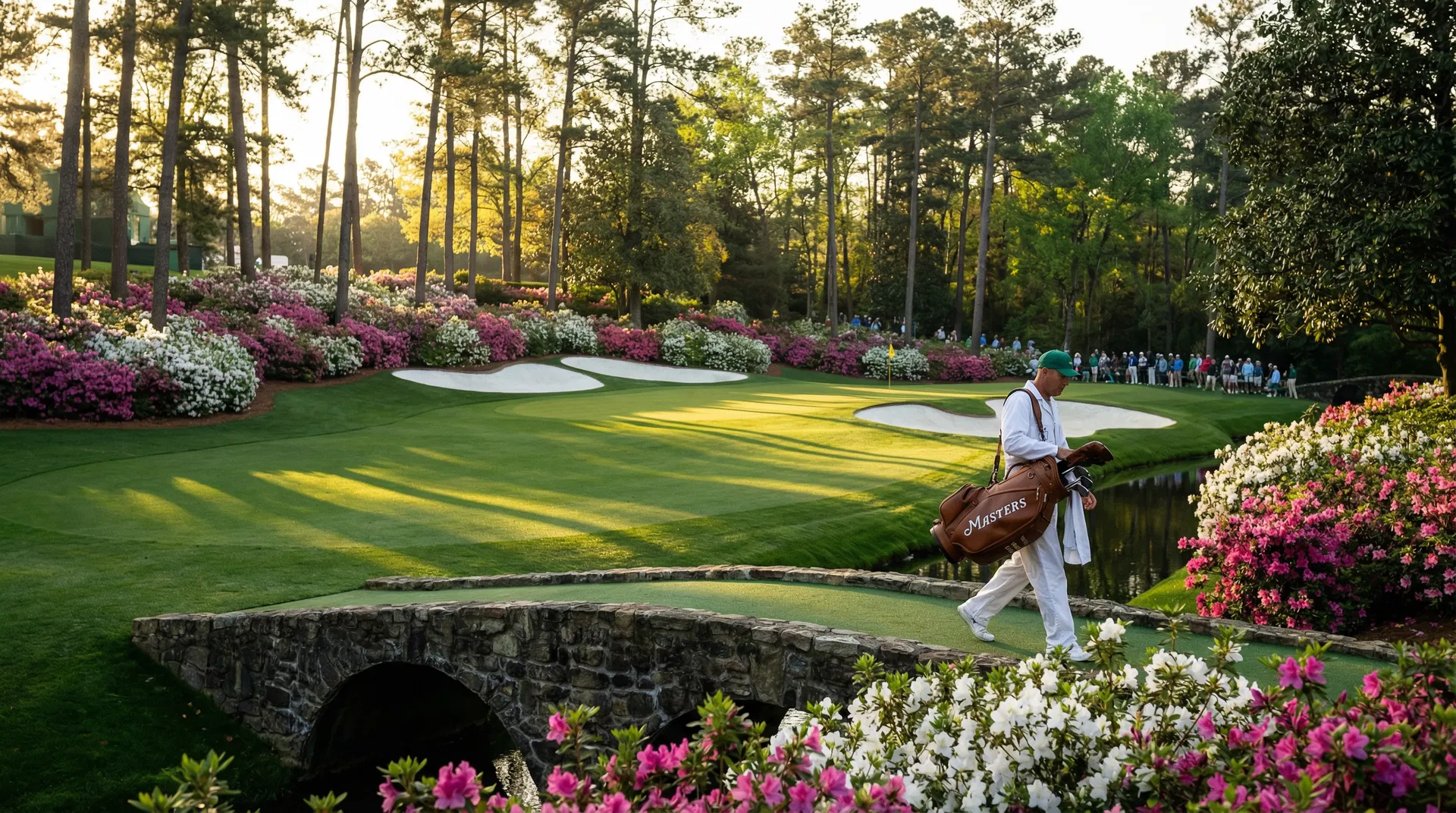
But the bag itself — the white TaylorMade Season Opener staff bag — communicated something beyond the equipment it contained. Staff bags at tour level are walking billboards, but they are also statements of intent. The white bag against the green of Augusta's fairways created a visual contrast that photographers instinctively sought out. Every image of McIlroy on the course that week included the bag in frame.
For club brands, the lesson is about visual identity. A bag that photographs well — that creates a strong visual contrast with its environment, that has distinctive design elements that are recognisable from a distance — generates organic marketing every time a member posts a photo on social media. This is not an accident at the tour level, and it should not be an accident at the club level either.
The 2026 Masters: Ghost Golf Raises the Bar Again
As the 2026 Masters gets underway at Augusta National, Ghost Golf has already released its latest Patrons Edition — and the response from the golf equipment community has been, if anything, even more enthusiastic than in 2025. The gold hardware detail that defined last year's bag has been refined, and the colour palette has evolved while remaining instantly recognisable as a Ghost product.
This consistency of evolution — changing enough to feel fresh, but maintaining enough continuity to be recognisable — is one of the hardest things to achieve in product design. It requires a clear brand identity, disciplined design direction, and the confidence to resist the temptation to reinvent the product every year.
For golf club brands building their own bag programmes, this is perhaps the most important lesson from Augusta week: build something distinctive, then evolve it carefully. The clubs and brands that members remember are not the ones that change their bag every season — they are the ones that develop a signature aesthetic and refine it over time.
What Augusta Week Means for Independent Golf Brands
The Masters is unique in golf for the intensity of attention it receives and the cultural weight it carries. But the principles it illustrates apply to every level of the market.
Limited-edition thinking, craft storytelling, visual identity, and consistent brand evolution are not strategies reserved for TaylorMade and Ghost Golf. They are available to any club or brand willing to invest the time and thought required to execute them properly.
The practical starting point for most clubs and independent brands is a single, well-designed bag produced in a defined quantity with a coherent story behind it. Not a generic bag with a logo, but a product that reflects the club's identity in every detail — the colour, the material, the hardware, the stitching, the lining.
That level of attention to detail requires a manufacturing partner who understands both the craft of bag-making and the commercial realities of small-batch production. It requires someone who can work from a brief, produce samples quickly, and maintain quality across a production run without requiring the kind of minimum order quantities that make sense for mass-market brands but not for clubs and independent labels.
The 2025 Masters reminded the golf world that equipment design, at its best, is not just functional — it is expressive. The bags carried at Augusta that week were not just containers for clubs. They were statements about who the brands behind them are, what they value, and what kind of golfer they are speaking to. That is the standard every golf brand should aspire to, regardless of size.
Update: The 2026 Masters — A New Chapter at Augusta National
April 2026 — The 90th Masters Tournament
The 2026 Masters Tournament, which began on April 9 at Augusta National Golf Club, adds another extraordinary chapter to the story that this article began telling. Rory McIlroy arrives as defending champion, carrying the weight of history after his 2025 play-off victory over Justin Rose completed his career Grand Slam — a moment that stopped the golf world in its tracks. Whether he can become the first back-to-back Masters champion since Tiger Woods in 2001 and 2002 is the defining question of Augusta week.
The 90th Anniversary: When Heritage Becomes a Design Brief
The 2026 Masters marks the tournament's 90th edition, and the golf equipment industry has responded with some of the most thoughtful limited-edition work in recent memory. Ghost Golf's Patrons Only 90th Edition stand bag is the standout example: heritage green-and-cream tones, gold hardware throughout, and a design language that speaks directly to the tournament's history without mimicking it. The bag sold out within days of its announcement, demonstrating once again that scarcity and storytelling are more powerful commercial forces than discounting and volume.
TaylorMade took a different approach for 2026, dedicating its Masters collection to the "unsung heroes" — the Augusta National grounds crew whose work makes the course what it is each April. It is a rare piece of brand storytelling that acknowledges the people behind the spectacle rather than the spectacle itself. For any golf brand thinking about how to build emotional resonance with its audience, TaylorMade's 2026 theme is a masterclass in finding an angle that is both authentic and unexpected.
Srixon's 2026 Masters bags drew directly from the iconic green-and-white striped umbrellas that line the Augusta National clubhouse, while Callaway's floral design paid tribute to the course's origins as Fruitland Nursery — the azalea flowers that now define the visual identity of Augusta week. Cobra, meanwhile, delivered a single head cover carrying the phrase "Nothing Like A Sunday In April", a line that needs no explanation to anyone who has followed the Masters. Each of these choices illustrates the same principle: the most effective limited-edition products are not designed in isolation. They are designed in conversation with a specific place, moment, or community.
The Field and the Stakes
The 2026 field brings together the full weight of modern professional golf. Scottie Scheffler, the world number one and reigning Olympic champion, enters as the betting favourite. Jon Rahm, Bryson DeChambeau, Xander Schauffele, and Ludvig Åberg are among the challengers. Justin Rose, who lost to McIlroy in last year's play-off, returns with a custom Cleveland wedge rebuilt from an archival head design — a detail that speaks to how seriously elite players take equipment customisation even at the highest level of the game.
Augusta National itself is playing firmer and faster in 2026 than in recent years, which analysts suggest could produce scoring in single digits under par for the first time in the modern era. The conditions reward precision over power — a reminder that the golf bag a player carries, and the equipment inside it, must be matched to the demands of the course, not just the preferences of the player.
What the 90th Masters Teaches Golf Brands in 2026
The pattern established at Augusta in 2025 has only deepened in 2026. The brands that resonate most strongly during Masters week are those that treat the tournament as a creative brief rather than a marketing calendar entry. Ghost Golf did not simply put a "90th Anniversary" badge on an existing product. TaylorMade did not simply add azalea flowers to a bag it had already designed. Each brand asked a more fundamental question: what does this moment mean, and how do we make something worthy of it?
For independent golf brands, club operators, and entrepreneurs building their own bag programmes, the lesson is the same in 2026 as it was in 2025. The tournament at Augusta is not just a sporting event. It is an annual demonstration of what happens when craft, identity, and storytelling converge in a single product. The brands that understand this — at any scale, in any market — are the ones that build lasting loyalty rather than transactional relationships.
The 90th Masters is still being played as this article is updated. Whatever the final leaderboard shows, the equipment and design stories from Augusta week have already confirmed what the best golf brands have always known: the bag you carry says as much about who you are as the score you post.
Share this article